
Forex Backtesting: Definition, Software & The Ultimate How-To
.webp)
Forex backtesting is the process of evaluating and validating trading strategies using historical market data. By simulating real market conditions, you can assess performance across different scenarios, identify your strategy's win rate and risk profile, and understand consistency—all without risking real capital.
Without backtesting, it is impossible to know whether a strategy has a genuine statistical edge or only occasional "good" profitable periods. This guide will walk you through how forex backtesting actually works, the different methods available, common mistakes to avoid, and how to transition from testing to real trading in a structured and practical way.
Let’s get into it.
What Is Forex Backtesting
Forex backtesting is applying a clearly defined trading strategy to past price data to see how it would have hypothetically performed under real market conditions.
Forex testing serves multiple purposes beyond just checking profitability. It helps you:
Unlike demo trading or live trading, backtesting allows you to:
- Analyse hundreds of trades in a short time
- Identify whether a strategy has a statistical edge
- Identify optimal parameters for indicators and trading rules
- Understand the risk profile of your strategy, including maximum drawdown
- Test ideas and validate your trading strategy before committing real money
Why backtesting is important in trading
The forex market operates 24 hours a day with trillions of dollars in daily volume. Without proper testing, you're essentially gambling with your capital. Backtesting in forex trading provides objective data about your strategy's performance across various market conditions—trending markets, ranging markets, high volatility periods, and low volatility environments .
Think of backtesting as a flight simulator for traders. Just as pilots practice emergency procedures in simulators before facing real emergencies, traders should test their strategies on historical data before risking real money. This practice can save you thousands of dollars in trading losses and years of trial-and-error learning.
A strategy that has never been backtested is not a strategy — it is a guess.
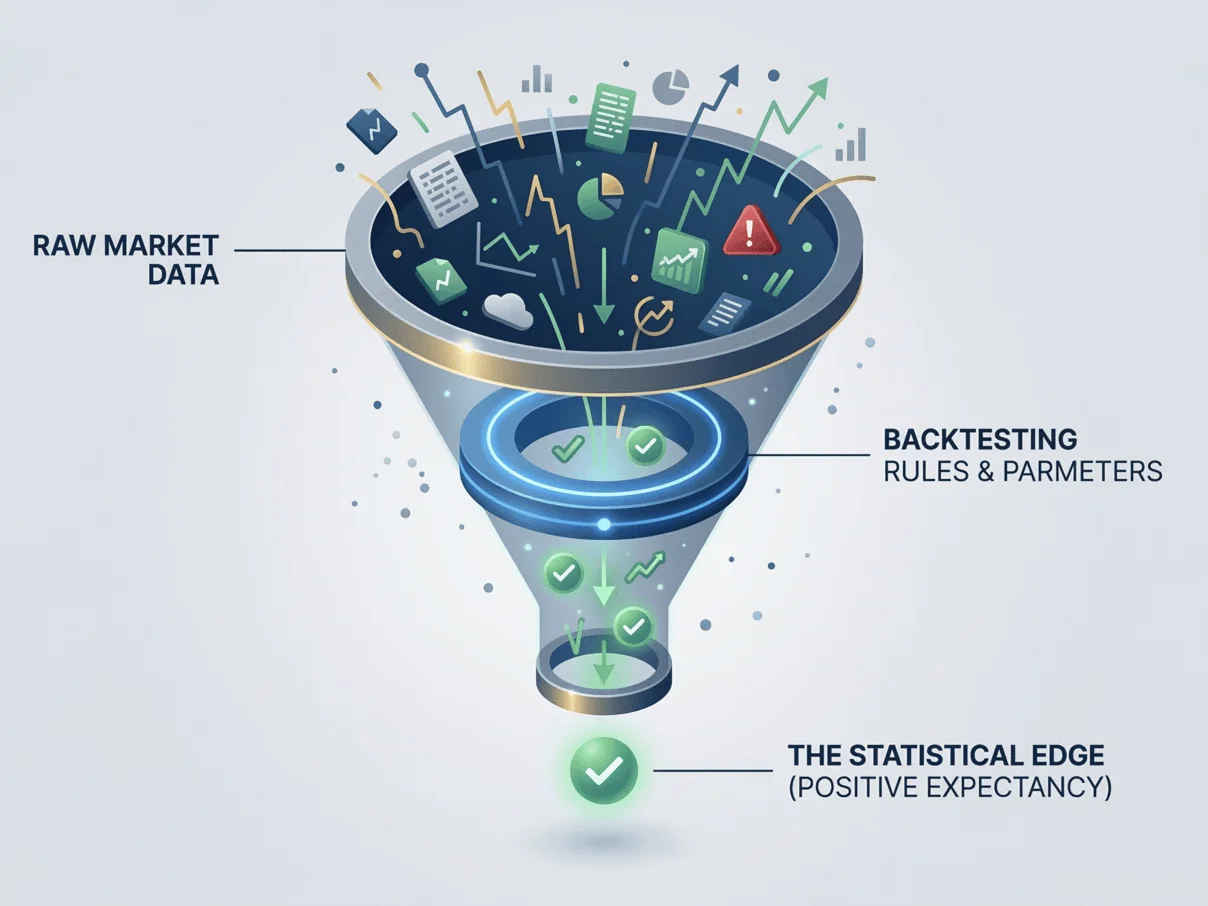
Backtesting does not guarantee future profits, but it helps answer critical questions:
- Does this strategy win more than it loses?
- How large are the drawdowns?
- Is the risk-to-reward sustainable?
- Does performance collapse during certain market conditions?
Types of Forex Backtesting Methods
Forex traders use different backtesting methods depending on their trading style, time horizon, and level of discretion. What matters is not the method itself, but whether it allows the strategy to be tested consistently and accurately without any biases.
Broadly speaking, forex backtesting methods fall into three categories:
- manual backtesting
- automated backtesting
- replay-based backtesting
Each approach serves a different purpose and comes with its own strengths and limitations.
Manual Forex Backtesting
Manual forex backtesting is when you are reviewing historical price charts candle by candle and recording trades exactly as they would have been taken in live market conditions. You scroll through past data without knowing what comes next, apply predefined rules, and log each trade outcome manually.
This method is particularly well suited to discretionary trading strategies, such as price action setups, chart patterns, market structure analysis, and higher-timeframe systems where context matters. Because every decision is made by the trader, manual backtesting closely mirrors the thought process required in live trading.
The main advantage of manual backtesting is realism. It forces traders to make decisions with incomplete information, manage trades in real time, and experience the uncertainty that comes with live markets. It also highlights execution issues that automated testing often ignores.
The drawback is speed. Manual backtesting is time-consuming and usually results in a smaller sample size. It also requires discipline, as it is easy to subconsciously skip losing trades or adjust rules mid-test if results are not recorded carefully.
Automated Forex Backtesting
Automated forex backtesting is using strategy testers to simulate trades automatically based on predefined, rule-based logic. Once the rules are coded or configured, the system can test a strategy across years of historical data in a matter of minutes.
The automated backtesting method is used for:
- Indicator-based strategies
- Mechanical trading systems
- Algorithmic or semi-automated approaches
The primary strength of automated backtesting is speed and scale. Large datasets can be analysed quickly, making it possible to assess long-term performance, drawdowns, and statistical reliability.
However, automated backtesting comes with important caveats. Results are only as reliable as the quality of historical data, the accuracy of the rules, and the assumptions built into the tester (such as spreads, slippage, and execution logic). Over-optimisation is also a common risk, where a strategy performs perfectly on past data but fails in live markets.
Automated backtesting is best viewed as a tool for validating core logic, not as a guarantee of future performance.
Replay-Based Forex Backtesting
Replay-based forex backtesting sits between manual and automated testing. It allows traders to replay historical market data as if it were unfolding live, candle by candle, while manually executing and managing trades in real time.
This method is especially popular among:
- Intraday traders
- Scalpers
- Session-based strategies
Replay-based testing offers a strong balance between realism and efficiency. Traders must wait for setups to form, react to price movement as it unfolds, and manage trades without knowing future outcomes. This makes it highly effective for testing execution timing, trade management, and psychological discipline.
While replay-based backtesting is slower than automated testing, it is often more realistic than traditional chart review.
Forex Backtesting Software
Forex backtesting software refers to tools and platforms that allow traders to test trading strategies using historical market data in a structured and repeatable way. While the core principles of backtesting are similar across markets, forex trading introduces specific considerations such as spreads, leverage, execution speed, and session-based volatility, which not all backtesting tools handle equally well.
Most backtesting software used for forex trading is not exclusive to currencies. Many platforms also support stocks, indices, and crypto. The key difference lies in how well the software simulates realistic forex trading conditions, including variable spreads, order execution logic, and intraday price behaviour.
Rather than looking for a “perfect” tool, traders should focus on whether a backtesting platform:
- Accurately reflects how trades are executed
- Allows consistent rule-based testing
- Provides meaningful performance statistics
- Matches their trading style and timeframe
Forex backtesting software generally falls into two broad categories: free tools and paid or professional tools.
Free Forex Backtesting Software
Free forex backtesting software is often the starting point for most retail traders. These tools are usually built directly into trading platforms or charting software and allow traders to test strategies without additional cost.
Free solutions are commonly used for:
- Learning how backtesting works
- Testing simple strategies
- Manual or semi-manual analysis
Typical characteristics of free backtesting tools include:
- Limited historical data depth
- Simplified spread and execution assumptions
- Basic performance reporting
Despite these limitations, free forex backtesting software is more than sufficient for developing and validating many trading strategies, especially on higher timeframes. In fact, many consistently profitable traders rely primarily on free tools, focusing more on strategy quality and discipline than on advanced features.
What matters most at this stage is not sophistication, but consistency in how strategies are tested and evaluated.
Paid Forex Backtesting Software
Paid forex backtesting software is designed for traders who require greater precision, deeper analysis, or faster testing workflows. These tools typically offer enhanced data quality, more realistic execution models, and more detailed performance statistics.
Paid solutions are often used by:
- Intraday traders and scalpers
- Systematic and algorithmic traders
- Traders testing large sample sizes
Common advantages of paid backtesting software include:
- Tick-level or high-resolution historical data
- Variable spreads and execution modelling
- Faster simulation speeds
- Advanced reporting and analytics
That said, paid software does not automatically produce better results. Without clear trading rules and disciplined evaluation, even the most advanced backtesting tools can generate misleading conclusions. Paid platforms should be viewed as amplifiers of a solid process, not replacements for one.


